
.
Treating mental health conditions often involves finding the right treatment, or set of treatments, for an individual based on their needs. There is a huge range of psychological treatments and ways of supporting people that are available both privately and through the NHS, and sometimes different treatments are offered in order to find the right one for a patient. When it comes to OCD, though, research is much clearer about what can successfully make a difference to people’s quality of life.
This document aims to provide information about treatments that might be mistakenly offered for OCD or related conditions, and why they are not recommended.
Therapies
The NICE guidelines for treatment of OCD refer to the fact that, even though we know CBT with ERP is the most successful treatment, mental health professionals might suggest a different therapy. This is most likely because of their own training, which might give them the impression that the type of therapy they work with will be appropriate for everyone. So far, research on other types of therapy hasn’t shown any others to reliably help to reduce or manage the symptoms of OCD.
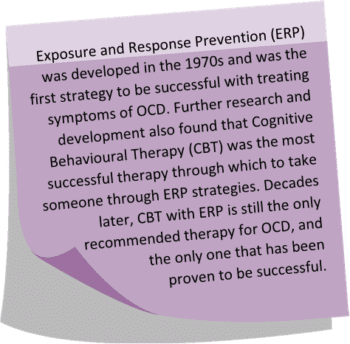 A likely reason why these therapies don’t affect the symptoms of OCD is that they have a focus on emotions and the self. While emotions are deeply affected by OCD, they are not the cause of it. Instead, OCD is the result of you becoming stuck in an obsession-anxiety-compulsion cycle. Therefore, emotional relief or understanding is unlikely to cure or treat the OCD itself. CBT with ERP works directly on the cycle it is trying to break.
Sometimes, elements or strategies from these therapies might be used alongside CBT with ERP to help you better understand or work with it. A therapist should always explain why they are using a particular therapy or technique and how it will help with the OCD symptoms.
When treating OCD symptoms, therapy must include methods designed around the OCD cycle, especially ERP. Otherwise, psychotherapy, including CBT, is much less likely to make a real or lasting change in your symptoms. Therapy aims to support you to build more resilience, make changes in your life, and connect with your own emotions. General therapy, though, works in a less specific way through the relationship with the therapist and self-exploration.
You might choose to attend counselling in their life for support with emotional distress or stressful periods, but this is unlikely to be helpful if you are looking for support with obsessions and compulsions specifically. This is because counselling often includes reassurance and work towards reducing anxiety, both of which would feed into the OCD cycle. People who attend general counselling for their OCD tend to feel like the therapy is helping, but it is most likely that they are using it for relief rather than to challenge and reduce the OCD cycle.
EMDR is a therapy used to treat the symptoms brought on by traumatic experiences, such as PTSD (Post Traumatic Stress Disorder) or flashbacks.
These symptoms are brought on by the memory of the events not being recorded into the brain correctly, so that the brain and body react to it as if it’s still happening, even years later. This therapy works by helping the brain to process the experience and learn to recall it from more of a distance. It can still be painful and scary, but it will feel like it happened in the past rather than the present.
Some local therapy services have recently been referring people with OCD to EMDR, but this is due to a misunderstanding of how it can help. EMDR doesn’t in itself reduce the OCD cycle of obsessions and compulsions, but it can be a part of making CBT with ERP more successful.
Some people experience traumatic intrusive images, thoughts, or memories as part of their OCD. OCD can also develop in response to a traumatic event. Sometimes this can cause ERP to be more difficult to engage with, because of the emotional impact of it. In these cases, EMDR or similar trauma treatments can be a very successful tool that would allow you to take part in CBT with ERP.
Psychoanalytic therapies focus on looking for the roots of current issues in past experiences, like why someone might always play the same ‘role’ with certain types of people or in groups. This can be actively harmful when working with OCD, as it brings the focus onto ‘figuring it out’ and analysing worries and experiences. This is more likely to feed into the OCD by putting more importance on the intrusive thoughts and what they might mean. The cause or trigger of someone’s OCD isn’t relevant to treating it, because the focus should be on getting ‘unstuck’ from the current cycle.
Research on the effectiveness of this type of therapy doesn’t show any reliable positive results on OCD symptoms, and indicates that the time taken for the treatment would make it not worth any successes it may bring.
CAT is a combination of CBT and Psychoanalytic work, which looks at how past experiences affect current ones within the context of looking at the connections between thoughts, behaviour, and feelings.
It can be useful for self-exploration and
making life changes. Like with psychoanalysis, one issue is that looking at the past doesn’t help treat OCD. The other issue is that, being based on generalised CBT, the lack of exposure within this treatment also means the symptoms of OCD aren’t being treated directly.
DBT is a very specialised style of CBT that is used to work with people who have difficulty with managing intense emotions and their responses to them. This therapy is based on intense levels of reliability and challenges to the person attending it.
People who struggle with OCD or related conditions, especially BDD, can find that managing their emotional reactions becomes more and more difficult because of the constant and distressing nature of their condition. If this happens, the focus should remain on treating the OCD symptoms, because emotional regulation will improve with this. Unfortunately, sometimes DBT or a similar treatment will be offered, incorrectly, by a mental health professional who is focusing on the external elements (not managing emotions) rather than the internal ones (obsessions and compulsions).
Hypnotherapy makes use of altering the client’s state of mind through hypnosis, in theory giving them better access to parts of their self or mind. It is considered a ‘complementary’ therapy rather than a psychological one, because there is no strong research-based evidence to suggest that it helps with mental health conditions. Some people have found it helpful with emotional problems or breaking habits.
Because it is used in helping to break habits, some people use it or suggest it for people with OCD. There is no evidence so far that hypnosis can reduce the symptoms of OCD or support you to recover from them, but there is a chance that the habit-breaking element can help to manage them a little more easily.
Mindfulness is a technique that uses focusing on the ‘here and now’ and being very aware of what’s happening in your mind, body, and emotions. It can be used to manage symptoms of mild anxiety or depression. Being more aware and focused on these things can help someone react differently to thoughts or feelings. It also includes concepts around patience and self-kindness.
Part of what keeps the OCD cycle going is how ‘sticky’ and worrying intrusive thoughts can be. Obsessions happen when you are unable to let go of irrational worries. Some of the principles of mindfulness, such as noticing thoughts without engaging with them, can be helpful as part of CBT in working on stepping back from the cycle. This would be one of the tools in your toolkit, though, rather than something that by itself will reduce the symptoms.
Trying to practice mindfulness can also turn into an unhelpful or actively harmful thing as well, though. The focus on sitting with thoughts and watching them go by can be confusing, and might bring more attention to them rather than help to ‘unstick’. You might feel that you have to ‘do mindfulness right’ and become more anxious in trying to achieve this.
.
Medication
Please refer to our Medication factsheet before reading this section
 Decisions around medication should always be made with a doctor. Individual differences like physical health and other medications can significantly affect what will be safe and successful for you. All of our information is based on the NICE (National Institute for health and Care Excellence) guidelines, which make general recommendations based on evidence-based research.
The following types of medication are explicitly listed as not appropriate for treating the symptoms of OCD.
Anti-depressant tablets that are not found in the list of recommended medications have not been shown to reliably reduce the symptoms of OCD. Non-recommended types of anti-depressant are SNRI, NASSA, TCA (except for Clomipramine), and MOAI.
Two non-recommended anti-depressants that are commonly prescribed for OCD are Venlafaxine and Mirtazapine. Venlafaxine is specifically named in the NICE guidelines as a medication that should not usually be prescribed for symptoms of OCD.
Mirtazapine is a different type of anti-depressant from the ones listed above and is not mentioned within the NICE guidelines. There isn’t any official guidance on whether it is a successful treatment for OCD, so it should not be considered until after the recommended medications are. Often, doctors choose to prescribe Mirtazapine over a recommended tablet because it can help with sleep. While sleeping better can be very helpful to recovery, a reduction of the OCD symptoms themselves will be even more so, and this is more likely to happen with a recommended tablet.
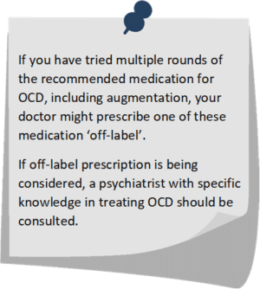
Certain tablets (sometimes called anti-psychotics) might be prescribed to boost anti-obsessional medication in cases of severe symptoms. This is called augmentation.
Confusion over this option and over the nature of intrusive thoughts can cause doctors to mistakenly prescribe dopamine-blocking medication on its own. The NICE guidelines specifically recommend against this.
Anti-anxiety medication keeps the body from getting into too heightened a state of anxiety, so will keep you more relaxed. This includes reducing physical symptoms of anxiety like heart palpitations and tight muscles. It does not, on the other hand, reduce the
frequency or intensity of the obsessions and compulsions.
Anti-anxiety tablets, also called anxiolytics, are only recommended for use carefully during the first few weeks of taking anti-obsessional medication, to help with the initial adjustment to them.
.
Neurological Interventions and Surgery
There are three types of neurological intervention that have been researched or used as treatment for OCD. These are Ablative Surgery, Deep Brain Stimulation (DBS), and Transcranial Magnetic Stimulation (TMS). None of these are currently recommended by the NICE guidelines, but they are being researched further.
Ablative surgery has been around since the 1960s as a treatment for the most extreme cases of OCD. It is also known as ‘lesion surgery’. It involves interrupting a brain pathway or ‘circuit’ by destroying a part of it. This can be done by drilling into the skull and using intense heat, or through the use of radiation.
Currently, ablative surgery is very occasionally offered through the NHS for individuals who have had multiple and recent unsuccessful rounds of treatment at the highest levels.
It has only been found to bring a small amount of improvement, so it’s only considered for people who have such severe OCD that the recommended treatments can’t work. In these cases, the surgery isn’t the final solution, but rather can be what makes the difference between the recommended treatments working or not.
DBS is a form of neurosurgery that has been historically used to treat Parkinson’s disease and is now being researched as a treatment for OCD. This surgery involves the insertion of thin wires into specific areas of the brain, which are connected to a battery pack and stimulate the brain on an ongoing basis.
Currently this is not available through the NHS and we don’t have any information on accessing it privately. NICE are reviewing their guidelines, and DBS is being considered as part of this.
TMS is currently used to treat migraines and depression and is being explored as a possible treatment for OCD. TMS involves placing powerful magnets to the outside of the skull in order to reduce activity in specific areas of the brain on a temporary basis. Repeating this regularly can successfully reduce mental health symptoms, though for the treatment of OCD this might need to be continued long-term for the effects to last.
Currently this is not available through the NHS and we don’t have any information on accessing it privately. NICE are reviewing their guidelines, and DBS is being considered as part of this.